GPT-6 Astra Found Questions My First Security Review Missed
I used GPT-6 Astra and Fable 5.1 as independent reviewers for RLS, API and tenant-isolation checks. The useful part was the structured cross-review.
Martin Rau ·
in AI Models
OpenAI's GPT series — the Sol, Terra, and Luna lines from GPT-5.6, joined since September 2026 by the GPT-6 line Astra.
I used GPT-6 Astra and Fable 5.1 as independent reviewers for RLS, API and tenant-isolation checks. The useful part was the structured cross-review.
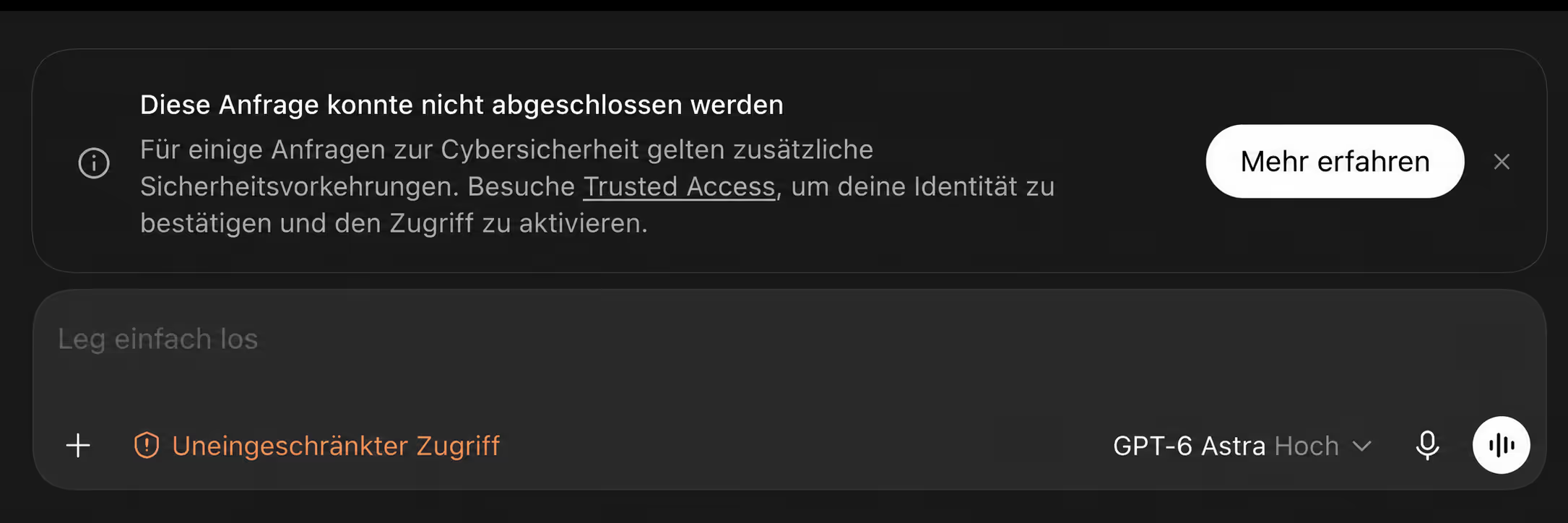
First Astra blocked my cybersecurity request. The hint led me to Trusted Access, identity verification and into OpenAI's Daybreak program.
Sol 6.1 resolves a merge with 12 conflicting files cleanly, Opus 5.5 reviews. Then it spends two hours fixing failures outside its task.
July 2026 in AI: Sonnet 5 and Opus 5 from Anthropic, GPT-5.6 after a US review, Kimi K3 as open weights, and new GEO controls in Search Console.
I wired GPT-6.1 Sol into boostN right after release. Early tasks run reliably. My first take, with a comparison chart. Detailed tests still running.
GPT-6.1 Sol (September 29, 2026) is OpenAIs low-cost coding and agentic model — the successor to GPT-6 Sol after just seven days, with near GPT-6 Astra intelligence at roughly a fifth of the price. Available via boostN.
GPT-6 Astra is OpenAIs flagship from September 2026 — the first model at the Critical Preparedness tier, focused on computer use and cybersecurity.
GPT Luna (GPT-5.6 Luna) is the smallest, fastest and most affordable model of OpenAIs GPT-5.6 family, released in July 2026. It is built for cost-sensitive, high-volume workloads and offers a context window of roughly 1.05 million tokens.
GPT-5.6 Sol is OpenAIs flagship from July 2026 — the top model of a new solar-system family (Sol, Terra, Luna) focused on coding, science and cybersecurity.
GPT Terra is the middle tier of OpenAIs GPT-5.6 family (July 2026), sitting between the efficient Luna and the flagship Sol — built for a strong price-performance balance with a 1M-token context.
OpenAI's real-time voice model, the default voice experience in ChatGPT since 8 July 2026. It listens and speaks at the same time (bidirectional), allows interruptions, and hands complex questions off to a stronger text model. Proprietary access via ChatGPT.
GPT-4o (May 2024) was OpenAI's first natively multimodal model — text, audio and image in a single model, with a real-time voice mode and substantially lower cost than GPT-4 Turbo.
GPT-4o mini (July 2024) is OpenAI's small, low-cost variant of GPT-4o — positioned as the successor to GPT-3.5 Turbo, clearly stronger at a much lower price per token.
GPT-5.2 is OpenAI's model generation from December 2025 — three variants (instant, thinking, Pro), a 400k context window and new state-of-the-art on professional knowledge work.
GPT-5.3 is an iteration of OpenAI's GPT-5 line — the Instant variant launched on March 3, 2026 with a focus on factual accuracy, shorter preambles and a more natural conversational flow.
GPT-5.3-Codex is OpenAI's specialized agentic coding model (February 2026), the successor to GPT-5.2-Codex — 25% faster, with substantial gains on Terminal-Bench and OSWorld.
GPT-5.3-Codex-Spark is OpenAI's coding model from February 2026 — a smaller, real-time-optimized variant of GPT-5.3-Codex delivering over 1000 tokens per second on Cerebras hardware.
GPT-5.4 is OpenAI's reasoning model from March 5, 2026 — the first mainline model with the coding capabilities of GPT-5.3-codex, native computer-use controls and 1M-token context.
GPT-5.5 is OpenAI's flagship from April 23, 2026 — positioned as its "smartest and most intuitive model" and pitched as a step toward AI that works across tools on its own.
The major model families in 2026 at a glance. Who builds Claude, GPT, Gemini, Llama, Mistral, DeepSeek, Qwen — and which model to pick when.
Claude, GPT, Gemini, Llama & co. — who builds what, where each family shines, and how to pick the right model for your own use case.
Daybreak Blue is not its own AI model, but OpenAI's vetted access to Sol with fewer security refusals for authorized defenders.
GPT-6.1 Sol: near Astra performance at a fifth of the cost. Benchmarks, pricing, limits and a selection guide against Opus 5.5 and Sonnet 5.5.
GPT-6 Astra is here: released September 2026. All the info on computer use, the Critical risk tier, reasoning, strengths & limits — in one lexicon entry.
GPT Luna is the entry tier of the GPT-5.6 family: fast and cheap for high volume. Positioning, use profile and a selection guide in one lexicon entry.
GPT Sol is OpenAI's flagship line in the GPT-5.6 family: the deepest reasoning and coding. Positioning, use profile and a selection guide in one entry.
GPT Terra is the middle tier of the GPT-5.6 family: balanced across capability, speed and price. Positioning, use profile and a selection guide.
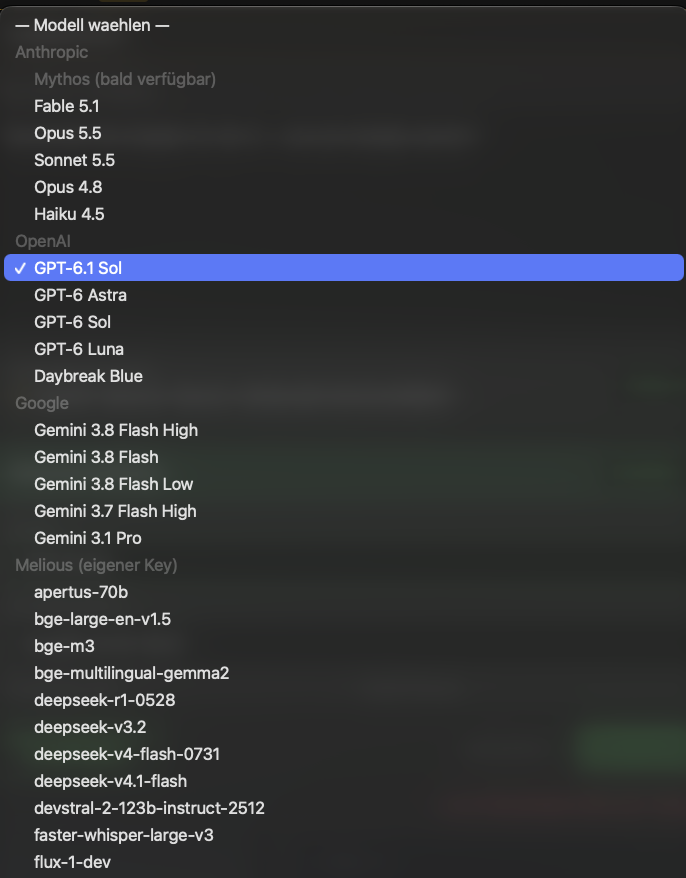
OpenAI released GPT-6.1 Sol: $2 / $10 per million tokens, near-Astra coding performance, but behind Anthropic's models on the overall index.
OpenAI shipped GPT-6 Astra — the first model to hit the Critical tier of its Preparedness Framework. Almost nobody has tested it independently yet.
OpenAI released GPT-5.6 (Sol/Terra/Luna) — but only after a pre-release review by the US government. What that means for frontier models.
Since August 2026, Daybreak Blue gives vetted defenders access to Sol with fewer cyber refusals. It is not a new AI model.
OpenAI closed the round end of March at $852B valuation. Who got in, what Amazon, Nvidia and SoftBank pay, what it means.
Since 5 May 2026, GPT-5.5 Instant is the new default model in ChatGPT. -52.5% hallucinations on law, medicine, finance — and fewer emojis.